I. Origins: Martyrdom in Zone 2
The history of the Ferans is not written with a pen, but with the scars that mark the backs of their elders. Natives of the scorching deserts of Zone 2 (Borea), these humanoid canids were not always the proud warriors we see today. For centuries, their existence was defined by the darkness of tunnels and the weight of shackles. The Scaraks, an insectoid hive race of cold and ruthless intelligence, considered them little more than biological tools, "burden livestock" destined to mine the mana crystals that fueled the Hive's underground empire.
Under the merciless sun of the dunes, Ferans were forced to work to exhaustion in open-pit mines. A slave Feran had no proper name; they were assigned a runic sequence branded into their skin. They were forbidden any form of cultural expression, the use of their native tongue, and, above all, the formation of pack bonds outside of work. The Scaraks knew that a Feran is only dangerous when they remember they belong to a pack, so they applied brutal isolation tactics for generations.
Despite this attempt at cultural erasure, in the shadows of the slave barracks, Feran identity survived. The "Language of Silence," a series of subtle gestures and growls, allowed the hatred for their captors to distill into a rebellion plan that would take decades to ripen. Rage did not fade; it became sand that erodes stone.
"They took our names, they took our sun, and they took our peace. But in doing so, they gave us a reason to fight that their hive minds will never understand."
II. The Night of Broken Shackles
Orbis's Year Zero brought chaos, and in that chaos, the Ferans found their opportunity. While the Scaraks attempted to contain the first Void rifts appearing in their domains, the rebellion exploded. Legend speaks of "The First Chainbreaker," an anonymous Feran who strangled a Scarak overseer with his own iron chains. That act was the signal. Within hours, the Zone 2 mines turned into a slaughterhouse.
The insurrection was visceral. The Ferans had no weapons, so they turned their shackles into flails and their mining picks into war axes. They didn't seek to conquer; they sought to eradicate. It was in this conflict that their current combat style was born: a frenetic dance of leaps, bites, and thrusts taking advantage of their canine physiology. By the end of the week, the surface of Zone 2 was littered with empty Scarak shells. The Ferans emerged from the depths not as slaves, but as "Chainbreakers," vowing that no creature, whether Scarak or Void, would ever put a collar on them again.
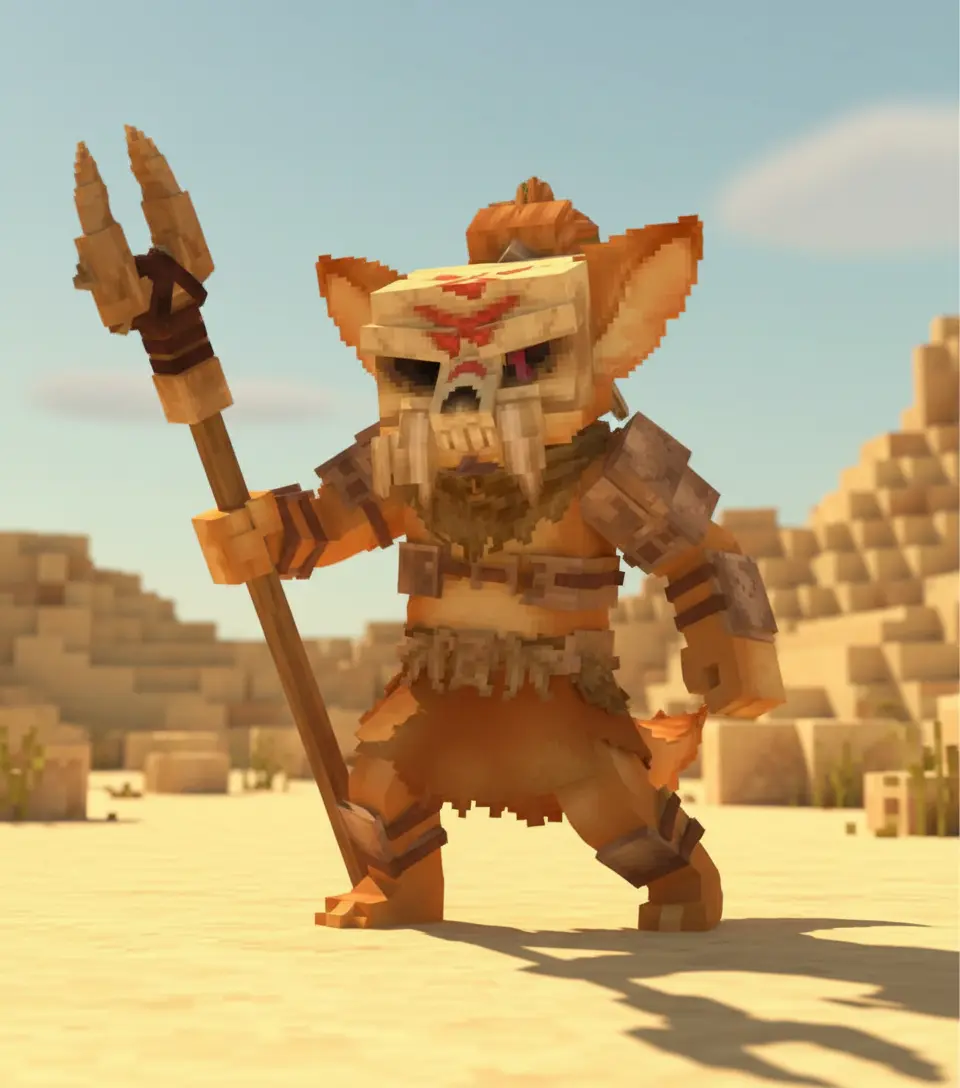
Detail of a Feran warrior carrying a mana crystal scimitar.
III. Society and Tactics: The Law of the Pack
Following their liberation, the Ferans adopted a semi-nomadic social structure based on merit and absolute loyalty to the pack. There are no kings among them; leadership is held by the "War Alpha," the one whose cunning and courage ensure the group's survival. Their culture is austere and pragmatic: every object they own must have a utility in combat or extreme desert survival.
On the battlefield, Ferans are the nightmare of the Void's heavy infantry. They despise metal armor for being noisy and limiting their natural agility. They prefer light desert beast leathers and war paint made from crystal dust. They are masters of ambush; they can bury themselves under the sand for hours to emerge as lethal shadows right in the center of an enemy convoy. Their preferred weapon is the curved scimitar, designed to inflict deep wounds on the move, and the throwing spear to bring down flying units.
IV. The Bond with Tessa's Resistance
The Ferans' union with the Alliance was not immediate. At first, they saw Tessa and her humans as another group of potential "lords." It was Tessa herself who earned their respect by challenging the Alpha of the largest Feran pack to a speed duel. Tessa did not use her lightning to win, but matched his tenacity, proving that her fight was for freedom, not dominance.
Today, the Chainbreakers are the Resistance's light cavalry. They ride "Sand-Runners," swift desert reptiles that can cover enormous distances without water. Their role is vital for the Mobile Bastion: they act as the army's eyes and ears, detecting Void patrols long before they realize they are being watched. For a Feran, fighting alongside Tessa is an extension of their own liberation.
V. The Threat of Scaraks and the Void
Despite their freedom, Ferans live in a state of perpetual war. The remains of the Scarak Hive, now corrupted by Varyn, constantly attempt to reclaim their "property." This unnatural alliance between the insectoids and the Void has given rise to the "Scarak-Void," armored nightmare creatures with magical powers that hunt Ferans for sport.
Tessa knows that if Zone 2 falls completely to this alliance, the Resistance will lose its greatest source of scouts and shock warriors. Therefore, the mission in the Present is clear: secure the sacred oases and destroy the corrupted Scarak nests. The Ferans will not back down; after tasting freedom, they would rather their race go extinct among the sands than feel the cold of metal on their necks again.