I. The Earth's Heartbeat: Dwarf Origins and Physiology
If the Kweebecs are the whisper of the forest, the Dwarves are the thunder of the mountain. Originating from the abyssal depths of Zone 4, this race has evolved in an environment where sunlight is a myth and volcanic heat is the only constant. Physically, the Dwarves of Orbis are models of biological resilience: they possess a bone density superior to humans and a concentrated muscular strength that allows them to handle heavy tools during exhausting days without rest. Their skin, hardened by centuries of exposure to volcanic gases and mine dust, has a texture similar to treated leather, making them naturally resistant to extreme heat.
But what truly defines a Dwarf is their introspective gaze. They possess vision adapted to the infrared spectrum, allowing them to "read" mineral veins within solid rock as if they were open maps. To them, stone is not inert matter; it is a historical record pulsating with Gaia’s energy. A Dwarf can determine the age of a cavern simply by listening to the echo of their footsteps, a skill that makes them the most advanced subterranean architects in the known world.
Socially, they are divided into Forge Guilds, hierarchical structures where an individual’s value is not dictated by lineage, but by the mastery of their work. The Grand Council of the Three Anvils governs their city-states, ensuring that technology and tradition walk hand in hand. For a Dwarf, leaving a work unfinished is the greatest of sins, as they believe every forged object contains a spark of its creator’s soul that must be honored for eternity.
"We do not measure our wealth by the gold we accumulate, but by the hardness of the steel we leave behind. A broken sword is an unfulfilled promise."
II. The Hammer and the Steam: Runic Technology
The genius of the Dwarves lies in their ability to merge runic magic with steam engineering. While other races depend on volatile spells, the Dwarves have learned to stabilize mana within pressure vessels and brass gears. Their forges are marvels of automation: massive pneumatic hammers driven by geothermal boilers that strike with the force of lightning, allowing them to work metals that would be impossible to mold by hand, such as runic steel or the elusive cobalt of the depths.
This technology is not limited to weaponry. The Dwarves have developed massive ventilation systems that purify the air in their cities and hydraulic elevators that connect the lowest levels of the world to the surface. Their mastery of steam is such that they have created defensive automata —small mechanical sentinels— that patrol the most dangerous tunnels, detecting the presence of Void creatures before they pose a real threat to the civilian population.
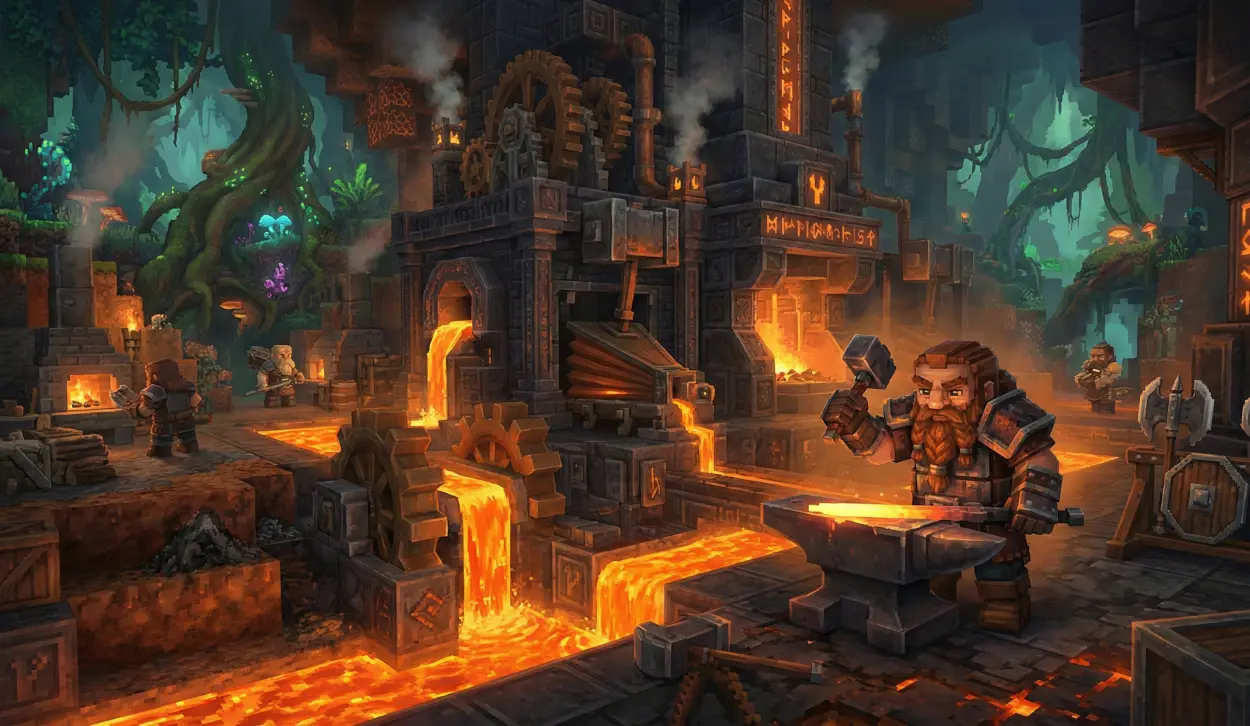
Detailed view of a Great Dwarf Forge operating with geothermal energy in Zone 4.
III. The Subterranean Bastion: Cities of Stone and Fire
Dwarf cities in Hytale are testaments to impossible architecture. Carved directly into the roots of mountains, these metropolises extend for kilometers downward in a labyrinth of circular plazas, lava aqueducts, and great halls supported by pillars carved with the effigies of their ancestors. The air in these places smells of ozone, coal, and hot metal—a perfume that any Dwarf considers the scent of home.
These fortresses are not just living centers; they are bastions designed to withstand centuries of siege. The main gates of a Dwarf city are so thick that it requires the coordinated effort of ten steam golems to open them, and their walls are reinforced with enchanted metal plates that dissipate dark magic. In the center of each city burns the "Guild Heart," an eternal forge that never goes out and serves as the spiritual nexus of the entire community.
IV. Steel Against the Void: Dwarves in War
When Varyn began his incursion into Orbis, the Dwarves were the first to feel the corruption in the depths. The Void does not just attack living beings; it also rots the earth and minerals. Seeing how their crystal veins darkened, the Dwarves knew neutrality was not an option. They have gone from being miners to the heavy infantry of the Resistance. Their plate armor is practically impenetrable to Varyn’s common minions, and their double-edged axes can cut through shadow itself.
Their main tactic is the "Iron Wall": a compact defensive formation where linked shields and mechanical spears create an impassable barrier. Unlike the Fauns, who prefer speed, the Dwarves prefer immovability. If a dwarf squad decides to hold a position, only direct intervention from Varyn or a total mountain collapse could move them.
V. The Alliance with Tessa: Suppliers of Hope
The relationship between Tessa and the Dwarves is a partnership of necessity and mutual respect. While Tessa provides strategic spark and mobility, the Dwarves provide the infrastructure necessary for war. It is they who supply the enchanted arrowheads for the Fauns, reinforcement plates for Gaia’s Golems, and precision tools for the Klops. Without dwarf steel, the Resistance would have crumbled under the weight of the Void’s numerical superiority.
For the player in Hytale, collaborating with the Dwarves means accessing the highest level of craftsmanship. Helping a guild recover a lost mine or defending a forge from a Scarak horde unlocks the ability to craft legendary equipment. At the end of the story, the Dwarves dream of a purified Orbis where the sound of their hammers becomes a song of creation once again, and not a war drum, reclaiming their ancestral halls to be, once more, the guardians of the world's heart.