I. The Awakening of the Goddess
Long before the first human empires drew maps, and eons before Varyn's shadow dimmed the stars, Orbis was nothing but cosmic dust and silence. It was then that Gaia awoke. Not as a being of flesh and blood, but as the consciousness of the planet itself. The oldest scrolls found in sunken temples tell that her first breath was not of air, but of pure magic.
Gaia did not build the world with tools, but with a song. A melody of elemental resonance that ordered the chaos. She separated the waters from the skies, raised the mountains with a whisper of tectonic force, and ignited the world's core with the fire of her own spirit. It was a golden age where magic needed no wands or staves to be channeled; it flowed freely like the wind, permeating every rock, river, and cloud.
In those days, the sun was not just a distant star, but a close guardian, and Orbis's moons orbited in a perfect dance of tides and light. There was no separation between the physical and ethereal worlds; spirits walked alongside matter, and reality was a malleable canvas under the Goddess's protection.
"And the Goddess looked upon her work, and saw that the balance was perfect. There was no light without shadow, but shadow was not evil, it was merely the rest of light."
II. The Geography of Paradise
The surface of Orbis in the Ancient Era was drastically different from the fractured land we know today. Zone 4, now known as the Devastated Lands, was then a tropical garden of impossible lushness, where water flowed upwards defying gravity and flora glowed with natural bioluminescence. It was the beating heart of the planet, a nexus of life energy so dense that trees themselves possessed consciousness.
To the north, Borea was not the freezing and unforgiving wasteland of today, but a region of crystal and light, where glaciers sang as they moved and auroras touched the ground, allowing inhabitants to walk among the sky's colors. The deserts of Zone 2, though arid, were vast expanses of golden sands dotted with oases that functioned as mirrors of the soul, sacred places where water healed any physical or spiritual wound.
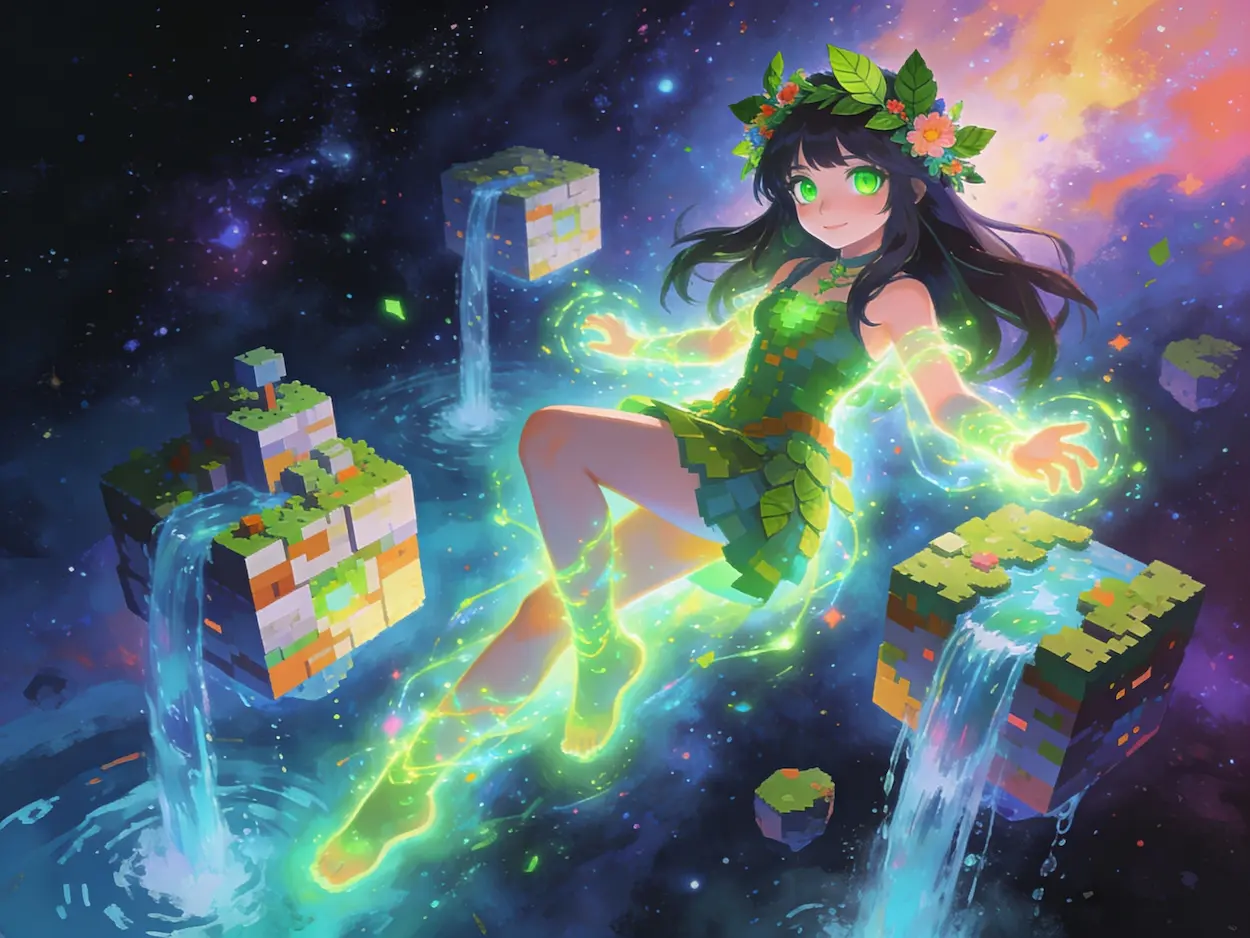
The birth of life on Orbis.
III. The First Children: Kweebecs and Elementals
With the stage set, Gaia desired company. Not servants, but observers who could appreciate the beauty of creation. From the bark of ancient trees and the essence of life, the Kweebecs were born. They were not created for war, but to be the gardeners of history. Immortal in their cycle, a Kweebec never truly dies; upon aging, they take root and become the elder trees that watch over the next generations.
But they were not alone. Elemental energies, so dense in that era, gained consciousness of their own. Stone Golems walked the mountain ranges like living peaks, and wind spirits danced above the floating islands of Zone 4. It is said that the ancestors of Ferans lived in the dunes, not as slaves to the Scaraks, but as proud nomads who mastered the wind. Even Trorks, today seen as beasts, were tribal artisans who honored physical strength as a divine gift.
IV. The Architecture of the Impossible
It was in the Ancient Era that structures which baffle us today were forged. The temples of Gaia, whose ruins still glow with pale light in dungeon depths, were erected not with cranes, but with will. Earth magic allowed rock to be molded like fresh clay.
The dungeons we explore sword in hand today were, back then, libraries of elemental knowledge and sanctuaries of meditation. The chests we now loot contained not spoils of war, but offerings of gratitude to the earth: star seeds, resonance crystals, and manuscripts on the language of beasts.
V. The Dissonance: The Prelude to the Fall
However, perfection is a fragile state. The abundance of magic acted as a beacon across the cosmos. While Gaia slept, dreaming of an eternal future of peace, at the edges of reality, something began to scratch at the walls of the universe.
It did not begin with an explosion, nor a sudden invasion. It began with a sound. A dissonant note in the song of creation. The Kweebecs were the first to feel it: an unusual dryness in their roots, a sudden silence in the songbirds. The Void did not burst into Orbis; it seeped in slowly like poison in a spring. The Ancient Era ended not with fire, but with a collective shiver down the spine of every living being: the first sensation of being watched.